It Was Eerily Quiet
I was excited about the lesson I designed for my classroom observation. Students made predictions about text we were reading. I projected a covered image from the story and slowly revealed the picture.
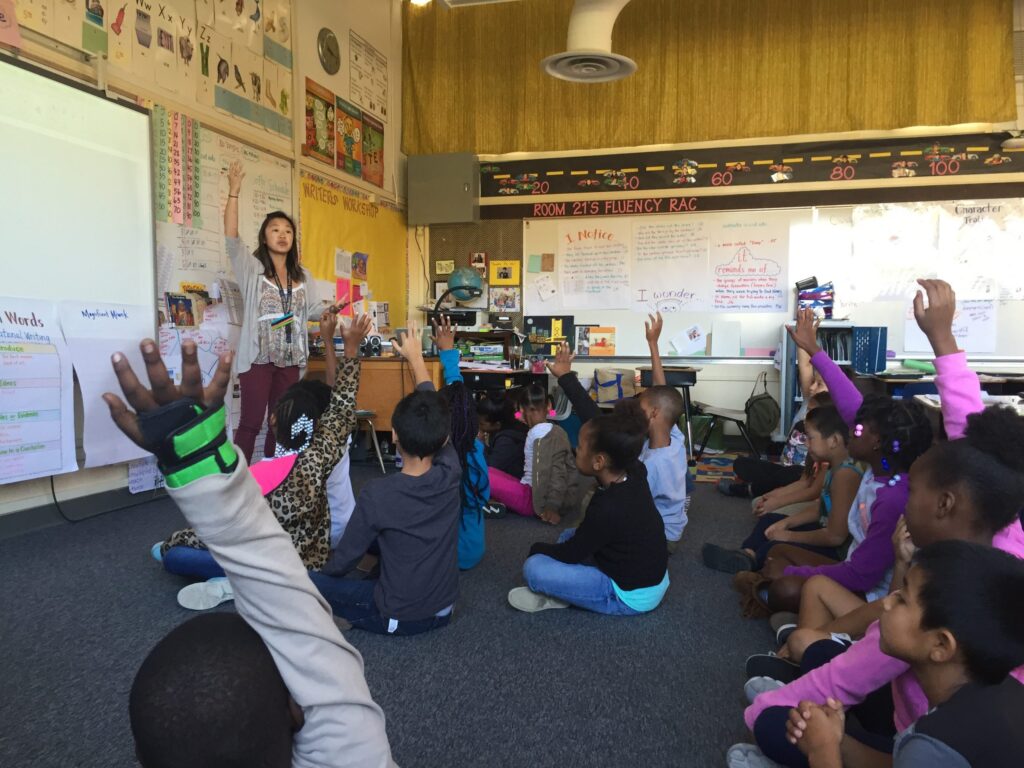
When I asked what the story might be about, one hand went up. I revealed another part of the picture. Two hands went up. I repeated this process a few more times. Students did not participate and I was frustrated. Later, my coach read back the transcript of my lesson and I realized that I never gave students time to talk to each other. No one was given time to test their ideas out before sharing with the whole class.
How many times have you asked students a question only to see a few hands raised? The class discussion becomes a conversation between you and a few students. Students who are not participating look on, are disengaged, and are allowed to become invisible.
As leaders of our classrooms we have a responsibility to engage our students – to facilitate and develop community and support students’ thinking about the content we are teaching.
We can engage students when they have multiple opportunities to turn and talk about information we are teaching.
Who Is Talking To Whom?
Take a moment to consider who is talking to whom. Who are students’ assigned partners at their seats and at the carpet?
We are granting permission for disengagement if we do not assign partners. If we ask students to choose a partner students might opt out, or be excluded, or be too shy to reach out and find someone. As teachers, one of our responsibilities is to structure interaction and make sure everyone has someone to talk to. Try the ideas below to ensure engagement and participation.
Pair-Share Paraphrase
- Assign students a partner and label each partner A and B.
- Give students 60 seconds to answer a question (“What did you do over the weekend?”) and have Partner A share their answer.
- Stop students after 60 seconds and ask Partner B to repeat back or “paraphrase” what Partner A said.
- Repeat the process so that Partner B answers the same question and Partner A can “paraphrase” what Partner B said.
Numbered Heads Together
- Number Students from 1-4.
- Ask students to discuss a question you have posed.
- Remind students to make sure everyone can answer the questions.
- Call a number (1, 2, 3, or 4). The student stands and reports their answer to the whole class.
Milling To Music
- Play music and ask students to walk around the classroom. Students make eye contact with students and say “Hi, how are you?”. Students respond by saying “I’m fine, thank you. How are you?”
- When the music stops, students stop. The person they are standing next to becomes their partner.
- Pose a question for students to discuss, review a problem they have solved, explain a definition to a vocabulary word they have researched, etc.
- Begin the music again. Students thank their partner for listening, move and greet other students. When the music stops, students stop, pair up, and answer the next question you pose.
Practice, Reflection, and Feedback
Building a strong classroom community takes work. Before using academic content, practice these strategies with students by using social prompts such as: My favorite season is… Someday I want to… After school I like to… My favorite food is… When I grow up I want to…, etc.
Ask students to reflect on the experience. How was the process? What was challenging about communicating with your partner? How did you feel? What would make the interaction even better?
Provide feedback to students by sharing what you noticed. Discuss students’ volume, body language, tone in conversation, and suggestions for improvement.
Students want to feel connected and included. Student discussion and collaboration can support a positive classroom environment. Give these strategies a try and let us know how it goes!